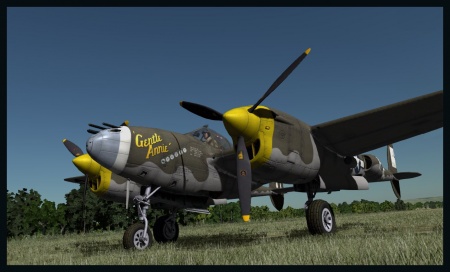
P-38J

Variant
of P-38 Lightning
Type Fighter/attacker
Crew Single-seat
Aces High II loadout
options
Package 1
4x .50
Cal M2 500 rpg
1x 20 mm M2 150 rpg
1x 20 mm M2 150 rpg
Package 2
4x .50
Cal M2 200 rpg
1x 20 mm M2 150 rpg
1x 20 mm M2 150 rpg
Options
6x 4.5"
M8 Rockets
2x 250lb bombs
2x 500lb bombs
2x 1000lb bombs
2x 150 gallon drop tanks
1x 150 gallon drop tank
1x 1K bomb + 1 drop tank
2x 250lb bombs
2x 500lb bombs
2x 1000lb bombs
2x 150 gallon drop tanks
1x 150 gallon drop tank
1x 1K bomb + 1 drop tank
Aces High II Main Arenas
Typical perk cost 0
ENY value 20
Available on carrier no
The P-38J is the midwar representaion of the P-38 Lightning. The P-38J in the game fits the profile to represent either the P-38J-10-LO or P-38J-15-LO production block. It has the same weight and power characteristics of the P-38L, but does not have the benefits of the boosted Ailerons, and Dive Flaps installed on later versions. It also lacks the more aerodynimic rocket mount configuration of the P-38L. The choice to fly the P-38J in the Late War Arenas often comes down to sentimental preferences, or skin selection.
Engine Power
The P-38J, like the earlier H version were powered by Allison V-1710-89/91. However, unlike the earlier version, the J had an improved intercooler design. This allowed it to have a War Emergency Power (WEP) rating up to 1,600 horsepower, and an increased military power rating of 1,425. In the game, the power related performance of the P-38J, is at a virtual dead heat with that of the P-38L.
Firepower
Outstanding, the P-38 is probably the class of the field when it comes to fighter mounted guns. Four .50 calibre machineguns are mounted along with a 20mm hispano cannon. Nose mounting ensures that convergence is not an issue (set out to D650) and concentration of fire is heavy. The nose mounting also gives an easy aiming reference since all weapons are firing on the center line. The match of .50 calibre and hispano is also good as they have similar ballistic properties at short-medium ranges. Cannon ammunition is limited to 150 rounds, about average for hispanos, but it won't last very long if you have a heavy trigger finger. You have two options for the .50's, either 200 rounds/gun or a whopping 500 rounds/gun in an overload option. While it can be tempting to take the 500 round option by default, the weight is more than double the smaller load and tends to last "too" long, making you stay around when maybe you should consider leaving instead. Shooting with the P-38 is so easy though, snapshots, deflection and even long range shots are about as easy as you can get with great effect. Even on difficult shots, the P-38 tends to deliver many hits in a short period of time and cause concentrated damage to enemy aircraft. Externally, the P-38 is also flexible aircraft for air-to-ground weapons. It can carry up to 6 rockets, as well as, two mounting points for bombs up to 1,000lbs in size. Ordinance options exist for many combinations of bombs and drop tanks so that you may not have to give up one or the other.
Maneuverability
The P-38 is big and heavy. At 17,500lbs and a wingspan of 52 feet compares to weights around half that and wingspans more in the 35-40ft range for most fighters. The P-38 is also easily over-loaded with ammunition, bombs, rockets and up to 410 gallons of fuel which is more than double the 137 gallons of a plane such as a Spitfire. Considering the amount of weight associated with all this, it's a wonder the P-38 can turn at all, but it can, and well. The P-38 in general can be considered an above average turner at most altitudes, both instantaneous and sustained, though not quite in the class of a Spitfire. Best sustained turn speed tends to be a little higher than some planes and the turn-radius is a little worse than average under most conditions. Flaps are available for use during combat but cannot be deloyed over 250mph. Use of flaps can greatly improve the turn radius and rate, but at a high cost in drag, so use should be limited to short periods. The P-38 can be dramatically hampered by weight, so trying to fight while heavy is a problem. Rolling response is reasonable once it is established though the large wing produces inertia related problems with starting or stopping a rolling motion. Stall handling is very gentle as the twin engine counter torque forces with each other, making for a gentle nose down motion at stall which is easily recovered. The P-38J can have dangerous high speed handling properties because of Mach buffet and compression though at lower altitudes there tends to be some warning. Over 20K, compression can occur at around 460mph and that can be troublesome but at low levels typically compression occurs around 500mph and long after Mach buffet and structural creaking are in full swing. Steep dives should be avoided that allow your P-38 to get out of control in speed, though throttling back and adding some slide-slip with your rudder is usually enough to maintain safe speed. If you do compress, use of manual elevator trim can help assist in dive recovery.
Fighting in the P-38J
Offensively the P-38J is a pretty decent plane being capable enough to make either a good BnZ'r or a good TnB'r. Usually the BnZ style is preferred until you know you have met an inferior turning opponent. Be careful when approaching the fight, you want to have lots of speed, but not excessive speed. You also don't want to get into a highly vertical dive on merge as the P-38J can accelerate out of control on you, quickly. Use the long range and beautiful trajectory of your guns to take lots of snapshots at any range within D800. Add the cannon into close firing situations when you think you can land hits. Getting slow and turn-fighting is acceptable though the danger level is higher. The P-38 is so large that even an average marksman can sometimes land hits at long ranges, being slow just makes that all the easier. Always try and fight as lightly as you can, take a drop tank and less internal fuel. A typical launch configuration includes one drop tank and only 50% internal fuel. You should also save your WEP as much as possible, just use the good climb-rate of the P-38 without sacrificing your WEP time to get to the battle. The P-38 also has flaps that can be useful when used at key times in order to increase turn-rate, though don't leave them out as they bleed speed quickly.
Defensively, the P-38 often has quite a bag of tricks, though you need to have a good feel for the P-38 to get the most out of it. If it weren't for the overly large size of the P-38 it would usually make quite a difficult target for most attackers. Hard turns and stall fights at the top of zooms tend to be primary to the P-38 tactics, where it exploits the neutral stalling characteristics and good turn-rate. The P-38, once rolling, can also be a real problem in a scissors as it can throw out flaps, input massive rudder, and sometimes the landing gear, in order to cause a very rapid overshoot problem for an attacker. The key really is to keep the enemy off target with the guns while you dance around and make him overshoot before he can react. Once he passes in front of you, your acceleration and lethal guns will likely end the fight before he can get escape. Always remember your aircraft size though as a bit of a handicap as it makes you a pretty large target for taking some sorts of hits and damage if the enemy can get in close. Slow turn-fights can be fine when you have only one enemy to deal with and he's in only an average turner, tighten up the turn as much as possible and wait for him to try and break off and run. Often, planes will stall out under torque and crash while trying to follow a slow turning P-38. Be very aware of your dive limitations, once over 450mph you are going to be in trouble as most aircraft will still maintain very good control but your P-38 will be almost helpless in maneuvering.
Fighting against the P-38J
The P-38J can be a tough opponent, especially if he is packing some altitude or speed advantage. There also seem to be a higher number of quality pilots who fly the P-38 and can cause you immense problems regardless of how good you are. Still, most popular planes seem to have one, or another, distinct advantage over the P-38J if they can manage to force the fight their way.
Offensively, the P-38 can be a tougher than expected target, and you can find yourself overshooting it quickly. The P-38 tends to like to break turn or get into a vertical stall fight where the stability of counter-rotating engines gives it a decided edge over the torque prone single engine planes. The counter-rotating engines also make it equally adept at breaking left or right, unlike most other planes which do better one way or the other. The classic defense from a BnZ'r in a P-38 tends to be a break turn, though not usually a descending one. This gives a nice large plane-view shot when you pass so take that opportunity and try to land hits. The large size of the P-38 tends to give a little more room for error when taking longer ranged shots, or where you may not be leading the aircraft quite enough. You'll notice that not leading enough still tends to put rounds on target in the tail region where in many other planes you might have just missed. Don't get suckered into slow turn-fights, the P-38, for all it's size, is a very good turn-fighter, though it depends quite a bit on how much weight the P-38 is still packing in fuel and stores. Only real TnB'rs should attempt extended turn-fights with a P-38 as I'd consider the P-38 in the top part of average and a little better than that when light of fuel. The P-38 will almost always try and force torque-prone aircraft like the Hog, La7, or 190's, into a stall fight and simply hope to stall you into the ground. Lag turns are particularly effective as they tend to cause the P-38 a lot of trouble keeping you in view while also keeping your speed up. The rear/downward areas of the P-38 are quite blind and it's difficult to defend against an enemy that you can't see. Always watch for the overshoot since the P-38 can slam the throttles closed, drop flaps and maybe even the landing gear. You may find yourself blowing right by into the area made entirely unfriendly by the P-38's fearsome guns. I've seen this type of overshoot work in a horizontal plane but it is even more deadly when vertical. In the vertical you may find yourself hanging with little control in front of a P-38 that is solid as a rock behind you and simply hanging on it's props while filling you full of holes.
Defending against a P-38 typically requires some knowledge of what area of performance your aircraft might hold in advantage. Remember, the P-38 is a balanced aircraft but has a couple of major handicaps at very high speed, because of poor views, a slow initial turn-rate, and mediocre low altitude speed against a number of opponents. Over-eager P-38 pilots can fall into a number of traps, usually involving scissors or high speed dives that can lead to loss of control or position. Good P-38 pilots usually realize the trap and break off early, leaving the enemy to flop around before re-engaging. If altitude is available, high speed can offer a level of security as many aircraft can dive safely away to lower levels. The P-38 really is limited to 450mph in a dive with the line being instant between full control and lawn-dart. In something like a P-47, the margin of dive safety may be more than 150mph. Never allow the P-38 to get any sort of shot on you within D800 though as they will all tend to spray the sky full of bullets, one or two of which may hit you and cause some sort of damage. If you are flying a premium turner, then you can also turn-fight the P-38 in most cases. The P-38 has a somewhat poor turn-radius and sustained turn-rate at low speeds, though it will temporarily compensate for that through the use of flaps. If you can hang in the fight until the advantage of the P-38 flaps is gone because of drag (say within about 10 seconds), then his sustained turn-rate will be really poor as compared to something like a Spitfire and you should quickly close up. Under these conditions, the Spitfire Mk IX can hold a 22.5 degree/sec turn-rate at 150mph and 3G almost forever while the P-38 can only hold that for an instant even with flaps, falling to something like like 17.5 degrees/second sustained.
You can also use the roll momentum problem of the P-38 to simply getting the enemy out of synch with you. Typically this involves a number of reversing rolls in short bursts and unpredictable so that the P-38 must change rolling direction/speed often. Once the enemy is out of synch, you can then apply a turn to break away from the P-38 while he tries to get back in phase so he can also turn. This can also be enhanced by making unpredictable turns into the P-38's blind spots to the sides and rear where you can follow up with additional maneuvers. Never let yourself get out in front of the P-38 though for even part of a second as the firepower will chew you to bits in only a moment.